Are you ready for the packaging demands of the future?
" Read more about: Are you ready for future packaging demands? "
Read more

As production lines become more complex and customer demands more specific, it becomes clear how quickly you hit the limits of what you can manage manually. Many companies have tried schedules, spreadsheets and routines that "usually work". But as the volume of orders increases, variants increase, and tolerances tighten, the system starts to creak.
This is where automation shows its strength: not as a replacement for human judgment, but as a systematic way to manage variation, sort through chaos and ensure the right item is in the right place - at the right time.
Implementing software-driven automation reduces waste, doubles efficiency and eliminates manual bottlenecks in an otherwise routine production. The solution is not one machine, but a fusion of software logic, robotics and a deep understanding of production flow.
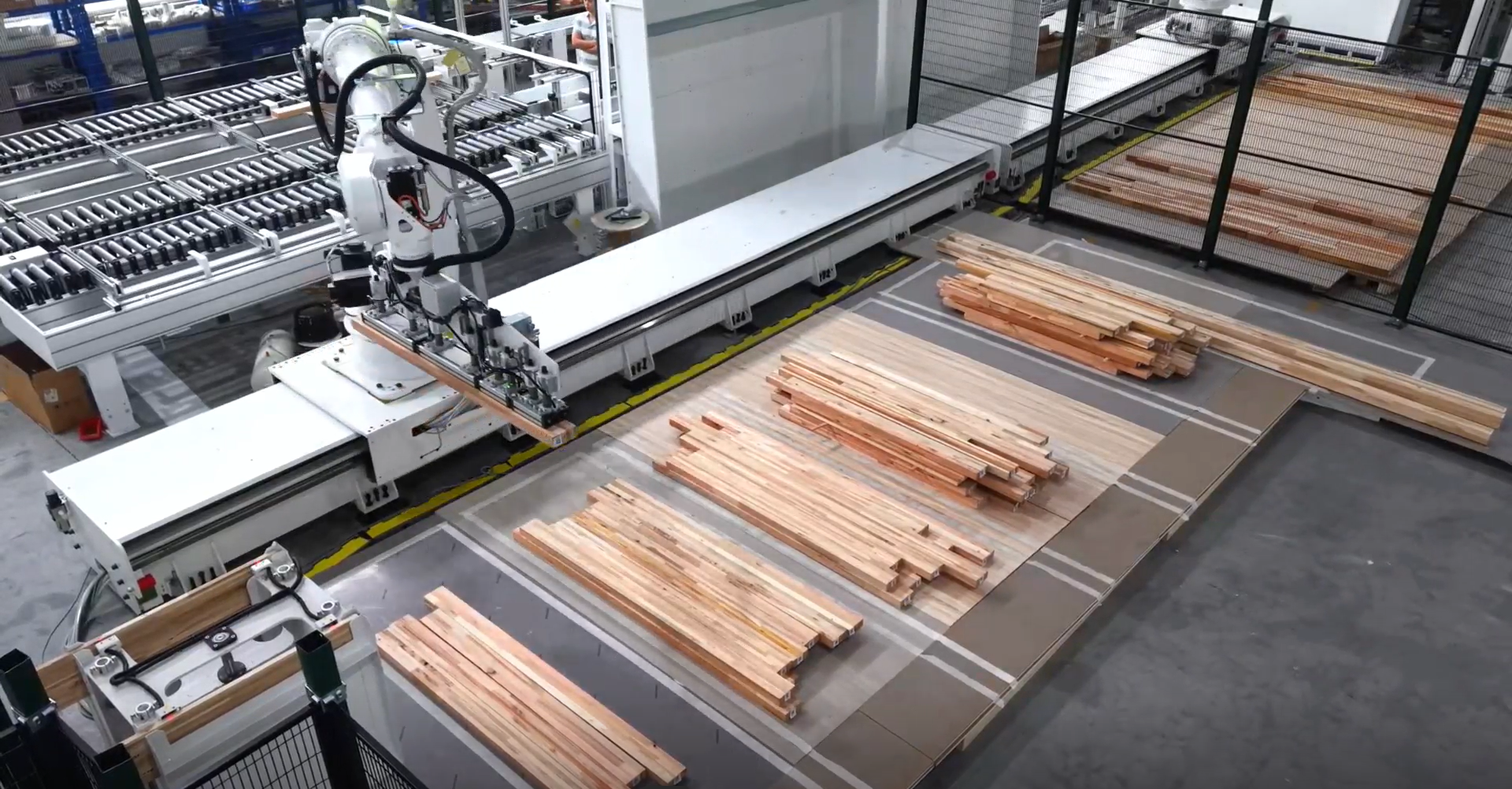
At the core of automation is an integrated solution where software acts as the central control system and coordinates a number of mechanical devices - including robots, conveyors and cross-cut saws.
The system's primary task is to create order in unstructured material flows that otherwise require extensive manual handling. Through precise control and logic in the software, items are sorted, packed and distributed according to dimensions, order and application.
From manual handling to intelligent flow
Before automation, processes were characterized by manual labor and repetitive manual decisions: Which pallet does this item go on? Who figures out where it goes? This led to errors and bottlenecks.
- Automate palletizing and sorting based on order data
- Track items from production to shipping
- Optimize shortening in relation to material consumption
- Eliminate errors and waiting time for manual handovers
- Example: A 6.3 m stick can be used more efficiently when planning, reducing waste by up to 50%.
- Process challenges are caught earlier in the process
- Eliminating heavy, repetitive lifting and inappropriate movements
- Each unit can be tracked through the production line
The software manages a total solution where items are distributed into structured packages after processing. Pallets are assembled according to customer-specific requirements - for example, windows for a specific building, where each item has defined dimensions and location.
- Automatic identification of items via barcode or measurement system
- Decision logic that determines packing, destination and prioritization
- Continuous control of length, quantity and sequence to ensure consistency and minimize deviations
There is no deep quality control (e.g. scanning for knots), but correctness in relation to order specifications and production logic is ensured.
Automation in this context is not just about machines - but about context. It's the link between physical equipment and digital intelligence that makes the difference. When data, production and logic work together, real production optimization happens.
The system doesn't make the operator redundant - it removes trivial tasks so that human insight is used where it adds value.
The case study shows how even relatively simple automation measures can create big effects. Increased uptime, reduced waste, improved working environment and higher end quality are not just goals - they are achieved.
Moving from manual routines to automated, software-driven production creates a platform that is scalable, stable and far more resilient to variation and growth.
In order for you to be sure to choose the right solution the first time for your production, you must choose a partner who gives you competent sparring through an open dialogue with a focus on building common values.
Read more